Research Fellow at Sunnybrook Hospital, Neuromodulation Expert
Research Interests
Non-Invasive Treatments for Better Brain Health
I’m a research professional with expertise in neuromodulation, plasticity, neuroimaging, and data science. During my 10 years in research and teaching roles across Australia and Canada, I have worked on projects to develop and improve cutting-edge techniques that use Transcranial Magnetic Stimulation, TMS, to promote better brain health. A major goal has been to understand how the state of the network impacts the focality of stimulation, in order to make treatments more reliable and efficacious.
I’m interested in questions like;
how can brain stimulation tools help us understand the neural basis for learning, memory and decision-making
how may we optimize neuromodulation tools in clinical settings
how can we achieve better targetingof brain networks using cognitive-tasks, closed-loop devices and functional-network-targeting with fMRI
where can TMS-biomarkers be used to predict the early signs of neurodegenerative disorders like ALS and dementia and help improve clinical care
Optimizing Brain Research
We can now measure and manipulate the brain like never before. Since 1990, fMRI offered a way to observe the brain in awake humans. But with no way to activate neurons, aside from a computer task or drug, our ability to make direct causal links was limited. With TMS, we can directly activate neurons and observe the changing neurophysiology, behaviour and function. We can make causal links between brain and behaviour in awake, functioning humans.
Magnetic brain stimulation offers a safe, and painless way to stimulate the brain. Since it’s approval in the early 2000s, TMS has been used to treat symptoms of depression, Parkinson’s, and OCD. Using repeated sessions of patterned stimulation in a specified protocol, TMS can produce a lasting change in neural circuits that has a therapeutic benefit.
The fact that TMS activates brain function without risky anesthetic or side effects means we can begin to offer patients an alternative to pharmacological or surgical treatments.
This is huge!
In depression, TMS is replacing electro-shock-therapy. Research on deep brain stimulation in Parkinson’s has shown it can have life-changing impacts. The list of TMS applications is constantly growing, with ongoing clinical trials in schizophrenia, stroke, substance abuse disorder, ALS, and more.
I work with an interdisciplinary team of doctors, therapists and scientists looking at ways to make these tools more reliable and use them to understand hard-to-treat diseases, like ALS. Every day I am grateful to be working at the forefront of this exciting field with such a dedicated team.
Expanding Neuromodulation Tools
A number of different techniques fall under the umbrella of neuromodulation. I specialize in transcranial magnetic stimulation (TMS) and neuroimaging (fMRI and EEG) which stimulate the cortex – the outer layer of the brain – responsible for aspects of movement, planning, attention and learning.
Some examples of tools being developed include:
transcranial magnetic stimulation (TMS)
repetitive and theta-burst TMS (rTMS and cTBS)
transcranial direct-current stimulation (tDCS)
functional magnetic resonance imaging (fMRI) guided TMS
electroencephalography (EEG)
focused ultrasound stimulation (FUS)
deep-brain stimulation (DBS)
closed loop brain-machine interfaces (BCI)
It takes a team
In my current job, I work with a team of highly-skilled doctors, clinicians and research coordinators to run ground-breaking clinical trials into ALS, a fatal neurodegenerative disease affecting the motor system. I get to supervise grad students and teach university courses on topics such as cognitive neuroscience, plasticity, attention, learning, and brain disease.
When I’m not in the lab, I write grants to help fund my research, speak about my work at international conferences, and collaborate to publish academic papers in high impact journals, such as Nature Reviews Neuroscience.
Clinical Applications of TMS in ALS
Everyday, in hospitals and clinics around the world, patients are receiving life changing brain stimulation treatment for severe depression. The origins of TMS date back to 1980, but it wasn’t until 2003 when methodical research began widespread. TMS was approved to treat depression the USA in 2008, Europe in 2012, and Australia in 2016. Treatment with TMS is only sometimes covered by provincial healthcare providers, like in some states of Canada, though is mostly self-funded. TMS is also used “off-label” to treat a range of symptoms related to stroke, Parkinson’s, addiction, OCD, neuro-degeneration and more. Clinical trials, like the ones I’m working on at Sunnybrook Hospital, continue to improve the efficacy and effectiveness of these treatments and improve patient outcomes.
JOURNAL ARTICLES Bradley, C., McCann, E., Nydam, A. S., Dux, P., & Mattingley, J. B. (2025). Causal evidence for increased theta and gamma phase consistency in a parieto-frontal network during the maintenance of visual attention. Neuropsychologia, 109079. Bradley, C., Nydam, A.S., Dux, P.E., Mattingley, J.B. (2022). State-dependent effects of neural stimulation on brain function and behavior.… Continue reading Publications
Let me set the scene: 47 tabs open. A grant application due in one hour. Emails and texts unread. More patient visits dropping into my calendar. Grad students asking to meet. And my coffee—a flat white—cold for hours. Leg tapping. Blink rate high. I’ve been staring at my screen for hours and I need to… Continue reading Why Smart Leaders Breathe Slow: The Science of Heart-Brain Resilience
In the last two decades, brain-computer interfaces (BCIs) have made remarkable strides translating neural signals into motor action programing. From robotic arms to mind-controlled quadcopters and speech processors controlled by thought, these innovations offer new and rousing possibilities for people living with paralysis, amputation, locked-in syndrome, and neurodegenerative disease. But for much of this journey,… Continue reading Beyond Movement: Embodied bionics for Brain Disease and Treatment
In the realm of neuroscience and medical technology, the dream of turning thought into action is no longer just theoretical. Brain-computer interfaces (BCIs) are fast evolving into viable, clinically meaningful tools, and transforming the lives of people with paralysis and neurodegeneration. Below I share three powerful examples of how far we’ve come, and where we… Continue reading Faster, Clearer, Closer: A New Era of BCI for Paralysis
Tackling disadvantage head on with curiosity and chocolate. The Wonder of Science program runs school-based STEM projects in rural schools and towns around Queensland on topics like volcanoes, water filtration, the solar system and more. My role as a Young Science Ambassador in 2018-2019 was one of the most rewarding experiences during my four years… Continue reading Inspiring a new generation of scientists in rural Queensland
Everyday in hospitals around the world, patients are receiving life changing treatments for depression using non-invasive brain stimulation tools. But how did we get here? Many years ago, a man put an electric eel on his head and noticed the brain changing effects. Fourty years ago, the first magnetic brain stimulation devices were being used. And… Continue reading Emerging tools for Brain Health


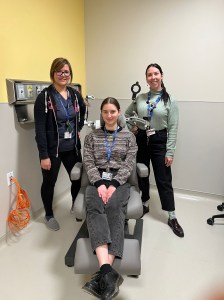

 Dr Abbey Nydam